Our lab is excited to share that Camelot, our computer automated micro extensometer with low cost optical tracking designed to measure the mechanical properties of plant tissues, is now published in BMC Biology. This project began as a way to create an accessible tool for researchers who want to investigate plant growth and morphogenesis through mechanical analysis without relying on expensive specialized equipment.
Camelot consists of three core elements, a force sensor with a sample attachment point, an actuator that applies controlled tension, and a camera for optical tracking. MorphoRobotX manages all components and records force, displacement and tissue deformation. This setup makes it possible to measure elasticity, creep and yield behavior even in delicate samples.
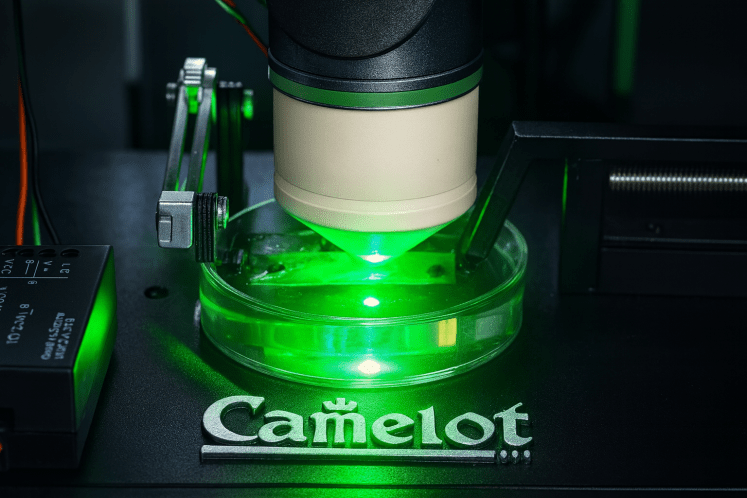
In the study we used Camelot to test etiolated hypocotyls of Arabidopsis thaliana and showed that the system detects stiffness differences between wild type and a xyloglucan deficient mutant. We also paired Camelot with inverted and upright confocal microscopes to track deformation at the level of individual epidermal cells. These experiments allowed us to observe anisotropic cell deformation during stretching and reveal how tissues respond to tension at both the cell and tissue scales.

Camelot’s portability, simplicity and compatibility with high resolution imaging make it an ideal tool for researchers studying cell wall mechanics, growth regulation and tissue behavior. Its low cost design also supports labs working in resource limited environments or those exploring new biomechanical questions.
Read more:
Camelot: a computer-automated micro-extensometer with low-cost optical tracking
Trozzi N, Wodniok W, Kelly-Bellow R*, Meraviglia A, Chételat A, Adkins N, Lane B, Smith RS✉, Kwiatkowska D✉, Majda M✉.
BMC Biol. 2025 Apr 28;23(1):112.



 The Mechanobiology Lab